As you dive into our Subaru Outback vs. Toyota RAV4 review, you'll notice that both SUVs enter 2026 with major updates. The RAV4 is now exclusively a hybrid, delivering notable fuel economy across every trim. Meanwhile, the Outback has been completely redesigned, emerging as a more spacious, capable, and adventure-ready SUV with generous standard amenities. Take a closer peek at how these two versatile competitors compare in this guide from Capital Subaru of Greenville.
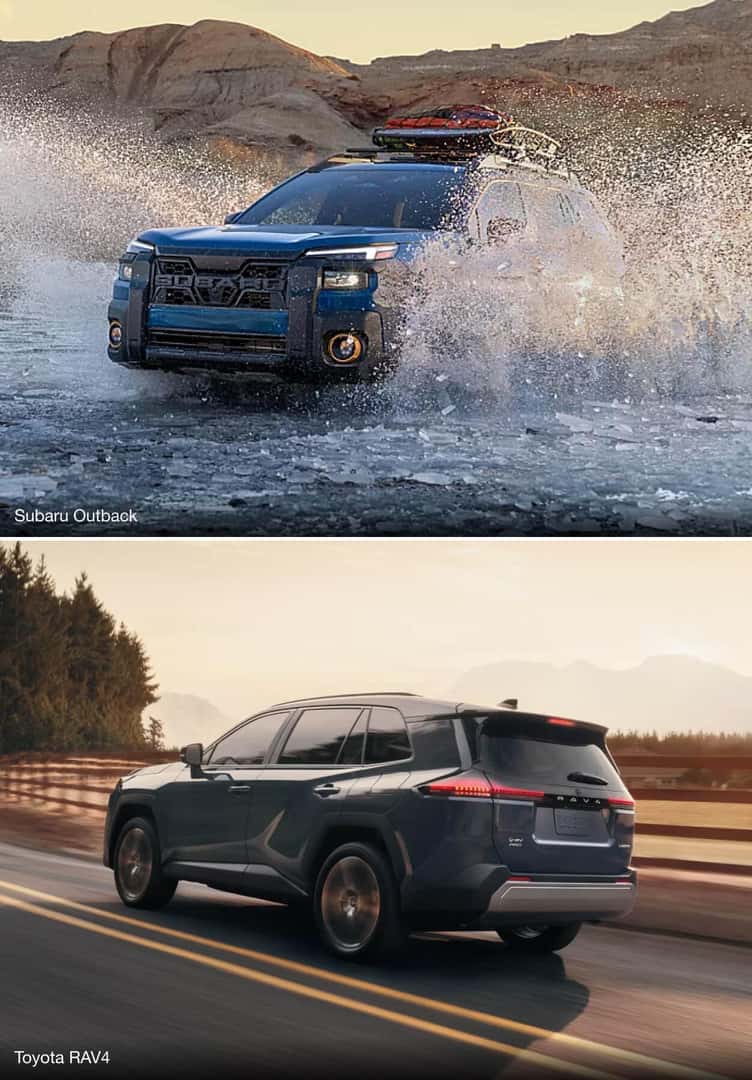
The 2026 Outback and RAV4 both start with a 2.5-liter four-cylinder engine, but they take very different approaches to performance. Every RAV4 now pairs its engine with a hybrid system, producing a combined 226 horsepower. The Outback relies on a naturally aspirated gas engine that generates 180 horsepower and 178 pound-feet of torque, edging out the 170 pound-feet of torque on the RAV4.
But the gap becomes incredibly noticeable when comparing the available powertrains. An enhanced hybrid system raises RAV4 output to a net 236 horsepower while torque remains at 170 pound-feet. Subaru answers with an available 2.4-liter turbocharged BOXER engine that delivers an impressive 260 horsepower and 277 pound-feet of torque.
Both SUVs start with a 2.5-liter engine, but the RAV4 hybrid peaks at 226 horsepower while the Outback reaches a higher maximum of 260 horsepower and 277 pound-feet of torque with its available turbocharged engine.
| 2026 Subaru Outback | 2026 Toyota RAV4 | |
|---|---|---|
| Standard Engine | 2.5L 4-cyl | 2.5L 4-cyl Hybrid |
| Transmission | CVT | CVT |
| Horsepower | 180 - 260 | 226 - 236 (net) |
| Standard Torque | 178 - 277 lb-ft | 170 lb-ft |
| Drivetrain | Symmetrical AWD | FWD / Available AWD |
| Towing Capacity | 2,700 - 3,500 lbs1 | 1,750 - 3,500 lbs2 |
| Max EPA-Est. MPG (Cty / Hwy / Comb) | 25 / 31 / 273 | 47 / 40 / 434 |
| Fuel Tank | 18 gal | 14.5 gal |
| Seating | 5 | 5 |
| Max Passenger Volume | 112.3 cu ft | 98.9 cu ft |
| Headroom (Front / Rear) | 41 / 40.5 in | 37.9 / 39.5 in |
| Legroom (Front Rear) | 43 / 39.5 in | 41 / 37.8 in |
| Max Cargo Space | 80.5 cu ft | 37.8 cu ft |
| Length / Width / Height | 191.7 / 74 / 67.5 in | 181 / 73 / 66.5 in |
| Wheelbase | 108.1 in | 105.9 in |
| Ground Clearance | 8.7 - 9.5 in | 8.1 - 8.5 in |
Fuel economy is one area where the hybrid-only RAV4 has the advantage. Even so, the Outback counters with an 18-gallon fuel tank compared to the 14-gallon capacity on the Toyota. That larger tank contributes to a maximum driving range of 558 miles, allowing for long stretches between gas stops.
Another major advantage of the new Subaru Outback is confidence in all weather conditions. Every 2026 Outback comes standard with Symmetrical AWD, whereas the RAV4 starts with front-wheel drive and requires an upgrade to gain all-wheel drive capability.
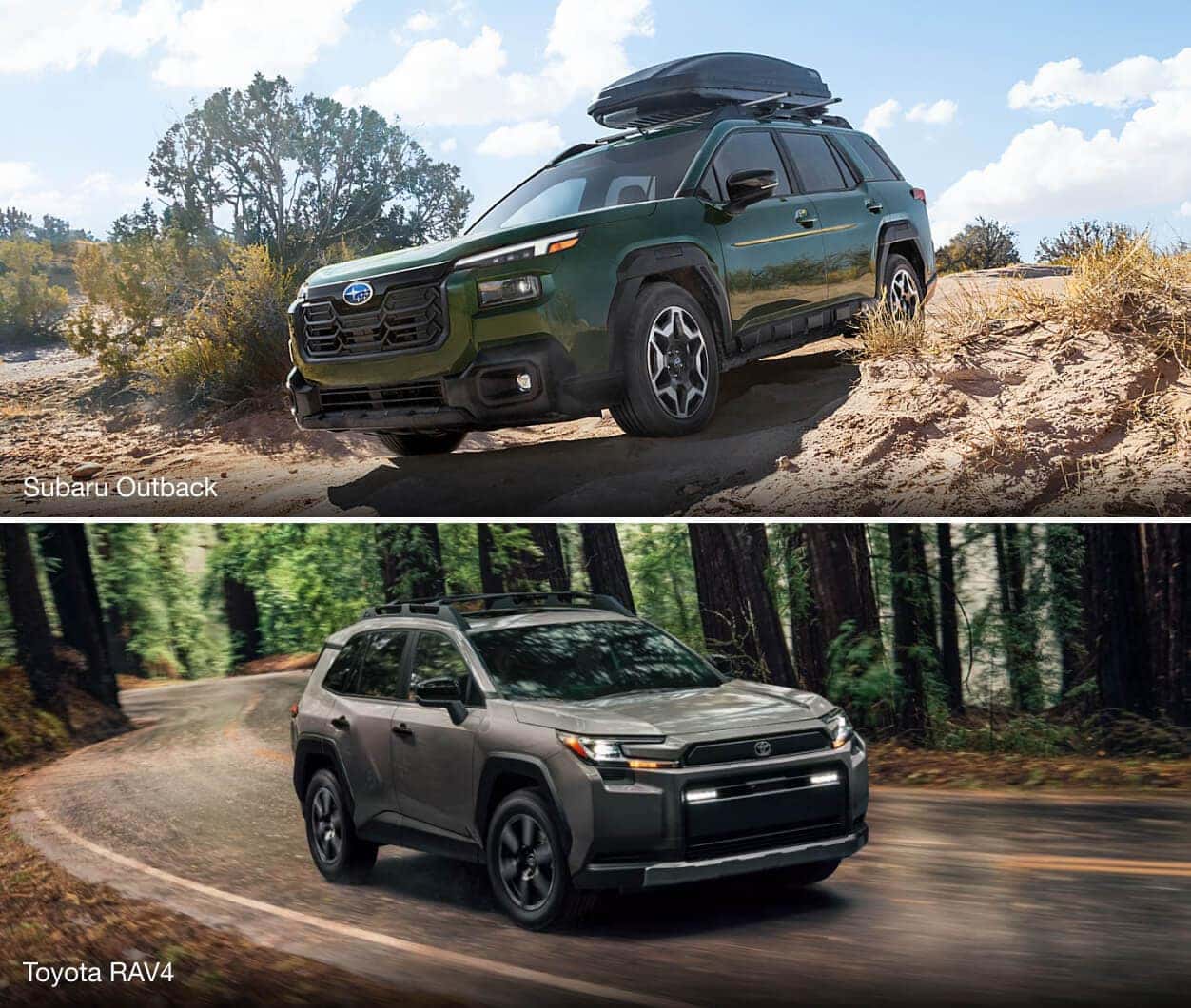
A closer look at the Subaru Outback vs. Toyota RAV4 infotainment comparison shows similar in-cabin technology. The RAV4 comes standard with a 10.5-inch touchscreen, with an available upgrade to a 12.9-inch display. The Outback has a standard 12.1-inch Multimedia system with available built-in navigation on top grades. Both SUVs include a 12.3-inch digital gauge cluster.
Audio systems are competitive in both models, with a standard six-speaker setup across their respective lineups. The RAV4 affords an available 9-speaker JBL® Premium Audio system, but the Outback provides an optional 12-speaker Harman Kardon® premium audio system, which is more widely accessible throughout its trims compared to the Toyota system.
Interior materials also differ in approach. The RAV4 starts with fabric seating and offers SoftTex or leather on higher trims. The Outback takes a more outdoor-focused approach with standard StarTex upholstery, with available supple-to-the-touch leather and Nappa leather on upper editions. Heated front seats and a leather-wrapped steering wheel also come standard in the Outback, adding more upscale amenities at the base level compared to the RAV4.
The RAV4 has a 10.5-inch touchscreen with an available 12.9-inch upgrade, while the Outback showcases a standard 12.1-inch system. Both include similar high-end audio options. The Outback adds more standard comfort features, including StarTex upholstery and heated front seats.
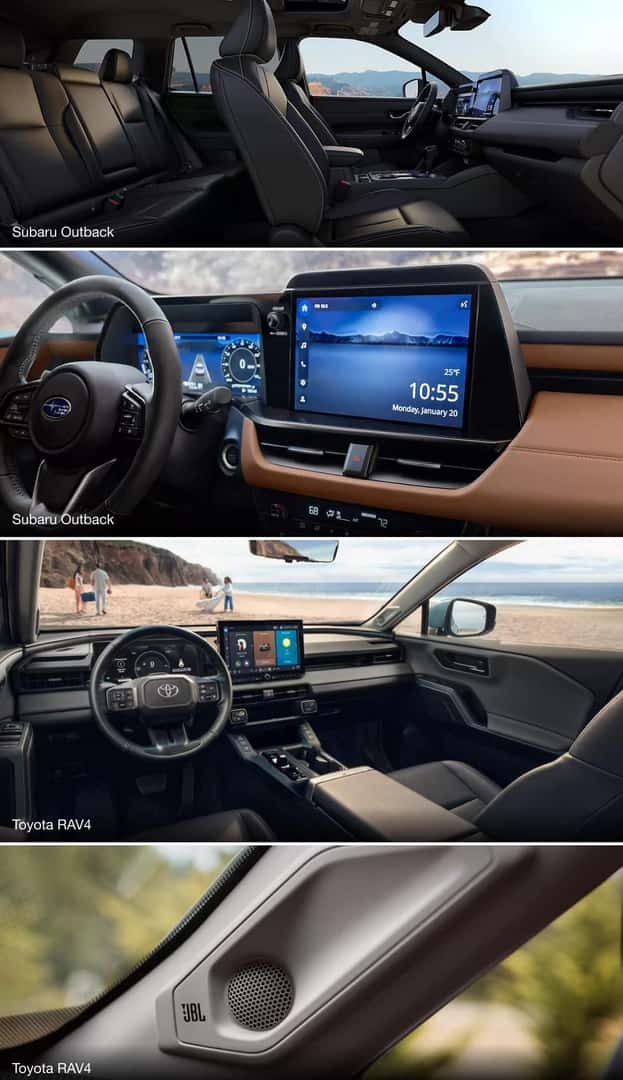
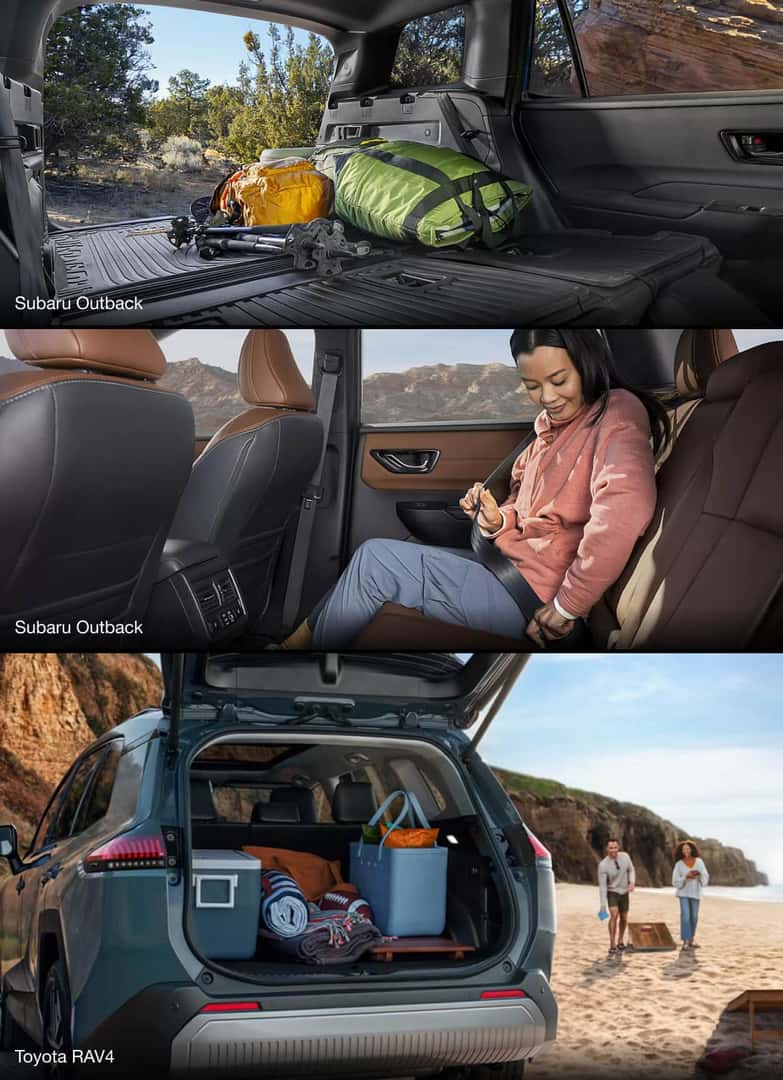
Both the Outback and RAV4 are two-row SUVs with seating for up to five passengers, but the redesigned 2026 Outback takes the edge in overall size and space. It presents more headroom and legroom, along with 112.3 cubic feet of passenger volume and a maximum cargo capacity of 80.5 cubic feet compared to 37.8 cubic feet in the RAV4.
The Outback is also larger in every dimension at 191.7 inches long, 74 inches wide, and 67.5 inches tall with a 108.1-inch wheelbase. The RAV4 measures 181 inches long, 73 inches wide, and 66.5 inches tall with a 105.9-inch wheelbase. Ground clearance further separates the two, with the RAV4 offering 8.1 to 8.5 inches, while the Outback starts at 8.7 inches and reaches up to 9.5 inches.
Both SUVs seat up to five passengers, but the Outback has more overall space with greater passenger volume and significantly higher cargo capacity than the RAV4. It's also larger in overall dimensions and has more ground clearance.
| 2026 Subaru Outback Trims | 2026 Toyota RAV4 Trims |
|---|---|
| Premium | LE |
| Limited | SE |
| Touring | XLE Premium |
| Wilderness | Woodland |
| Limited XT | XSE |
| Touring XT | Limited |
Both the 2026 Toyota RAV4 and Subaru Outback can tow up to 3,500 pounds when properly equipped. However, the Outback maintains a higher minimum towing capacity of 2,700 pounds.1 The RAV4 SUV's base towing capacity drops to just 1,750 pounds2 – a stark difference!
For 2026, the Toyota RAV4 transitions to an exclusively hybrid lineup, giving it a clear advantage in fuel economy over the 2026 Subaru Outback. However, that extra efficiency comes with a few compromises. The RAV4 is smaller overall, providing less cargo volume, tighter seating in both rows, and lower maximum torque and horsepower than the Outback.
The 2026 Subaru Outback offers significantly more cargo space than the Toyota RAV4. With up to 80.5 cubic feet of maximum storage capacity, the Outback brings more than double the maximum cargo area of the RAV4, which measures 37.8 cubic feet. Contact Capital Subaru of Greenville to see the roomy interior of the Outback for yourself.
1Maximum towing capacity varies by trim level. Trailer brakes may be needed. See your retailer for details.
2Before towing, confirm your vehicle and trailer are compatible, hooked up and loaded properly and that you have any necessary additional equipment. Do not exceed any Weight Ratings and follow all instructions in your Owner’s Manual. The maximum you can tow depends on base curb weight plus the total weight of any cargo, occupants, and added vehicle equipment. “Added vehicle equipment” includes additional standard/optional equipment and accessories added by the manufacturer, dealers, and/or vehicle owners. The only way to be certain of your vehicle’s exact curb weight is to weigh your vehicle without passengers or cargo. (Calculated with the new SAE J2807 method.) Installation of a tow hitch receiver or other accessories located near the rear bumper or side-door kick sensors may require disabling or removing the kick sensor, and the sensor operation setting in your vehicle should be turned off. See Owner’s Manual for limitations.
3EPA fuel economy estimates. Actual mileage will vary with driving conditions and your vehicle’s condition.
4Use for comparison purposes only. Your mileage will vary for many reasons, including your vehicle’s condition and how/where you drive. See www.fueleconomy.gov.