A Subaru Forester Hybrid vs. Toyota RAV4 matchup puts two compelling choices side-by-side for drivers seeking a compact SUV with sporty styling and hybrid efficiency. A closer look at the latest models from Capital Subaru of Greenville reveals several areas where we believe the Forester Hybrid has an edge over its Toyota competition.
| 2026 Subaru Forester Hybrid | 2026 Toyota RAV4 | |
|---|---|---|
| Engine | 2.0L 4-cyl | 2.5L 4-cyl |
| Net Horsepower | 194 | 226 - 236 |
| Drivetrain | Symmetrical AWD | FWD / AWD |
| Max EPA-Est. MPG (Cty / Hwy) | 35 / 34 / 351 | 47 / 40 / 432 |
| Dimensions (L / W / H) | 183.3 / 72 / 68.1 in | 181 - 182 / 73 - 74 / 66.7 - 67.1 in |
| Ground Clearance | 8.7 in | 8.1 - 8.5 in |
| Headroom (1st / 2nd Row) | 40 / 37.7 in | 37.9 / 39.5 in |
| Legroom (1st / 2nd Row) | 43.3 / 39.4 in | 41 / 37.8 in |
| Passenger Volume | 106.6 cu ft | 98.9 cu ft |
| Cargo Volume (Standard / Max) | 27.5 / 69.1 cu ft | 37.8 / 70.4 cu ft |
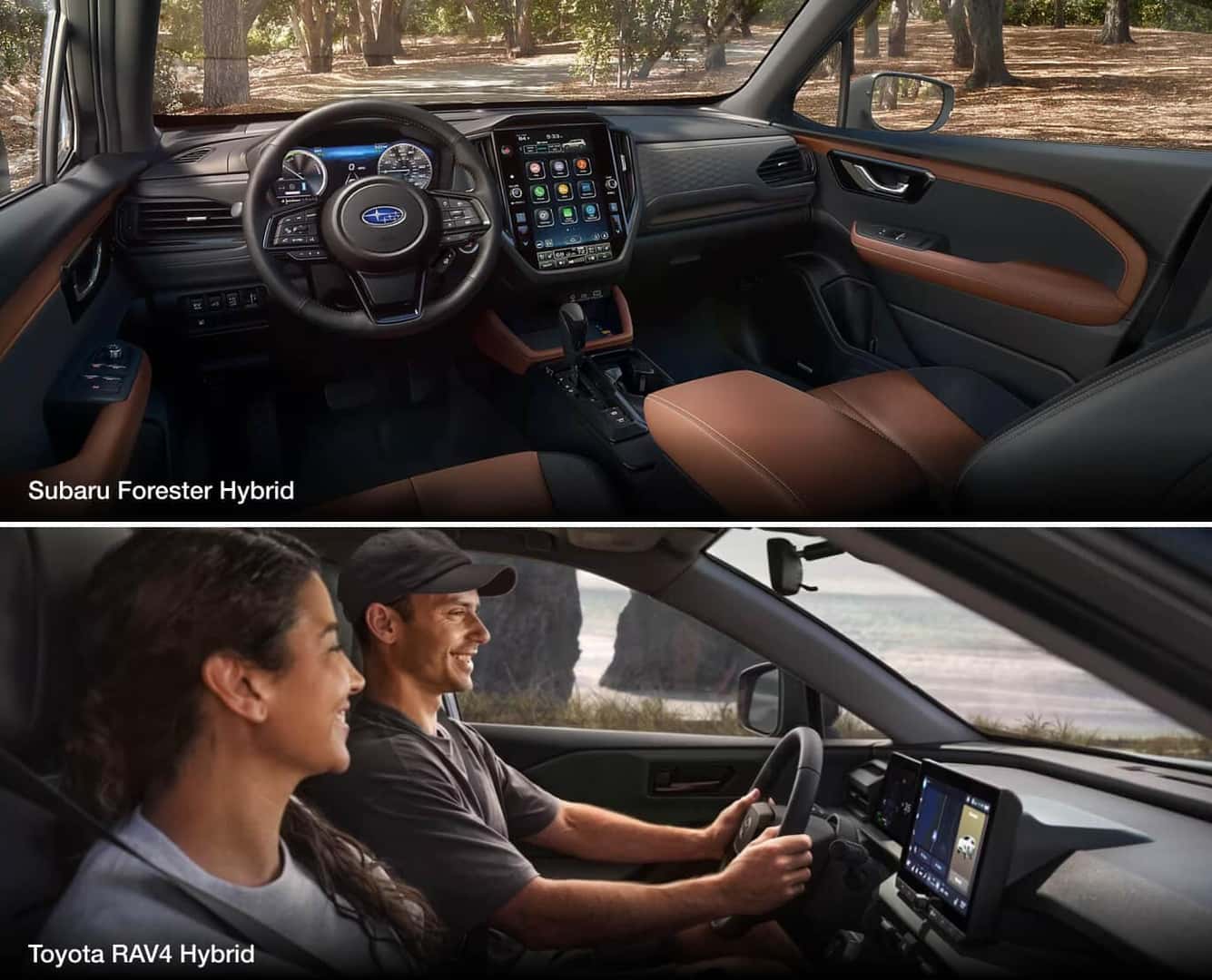
Every new Subaru Forester Hybrid starts with a 10-way power-adjustable driver's seat and panoramic power moonroof. The RAV4 doesn't match that combination at its entry point, and even its highest trim uses an eight-way power-adjustable front seat.
Subaru also provides available StarTex water-repellent upholstery, ventilated front seats, and a heated steering wheel for motorists who spend time outdoors. The RAV4 counters with upgradable SofTex seating, but its interior choices don't go as far. For instance, leather-trimmed seating is available on the Forester Hybrid, whereas the RAV4 stops at leather-wrapped steering wheel and shifter surfaces rather than having a comparable seating upgrade.
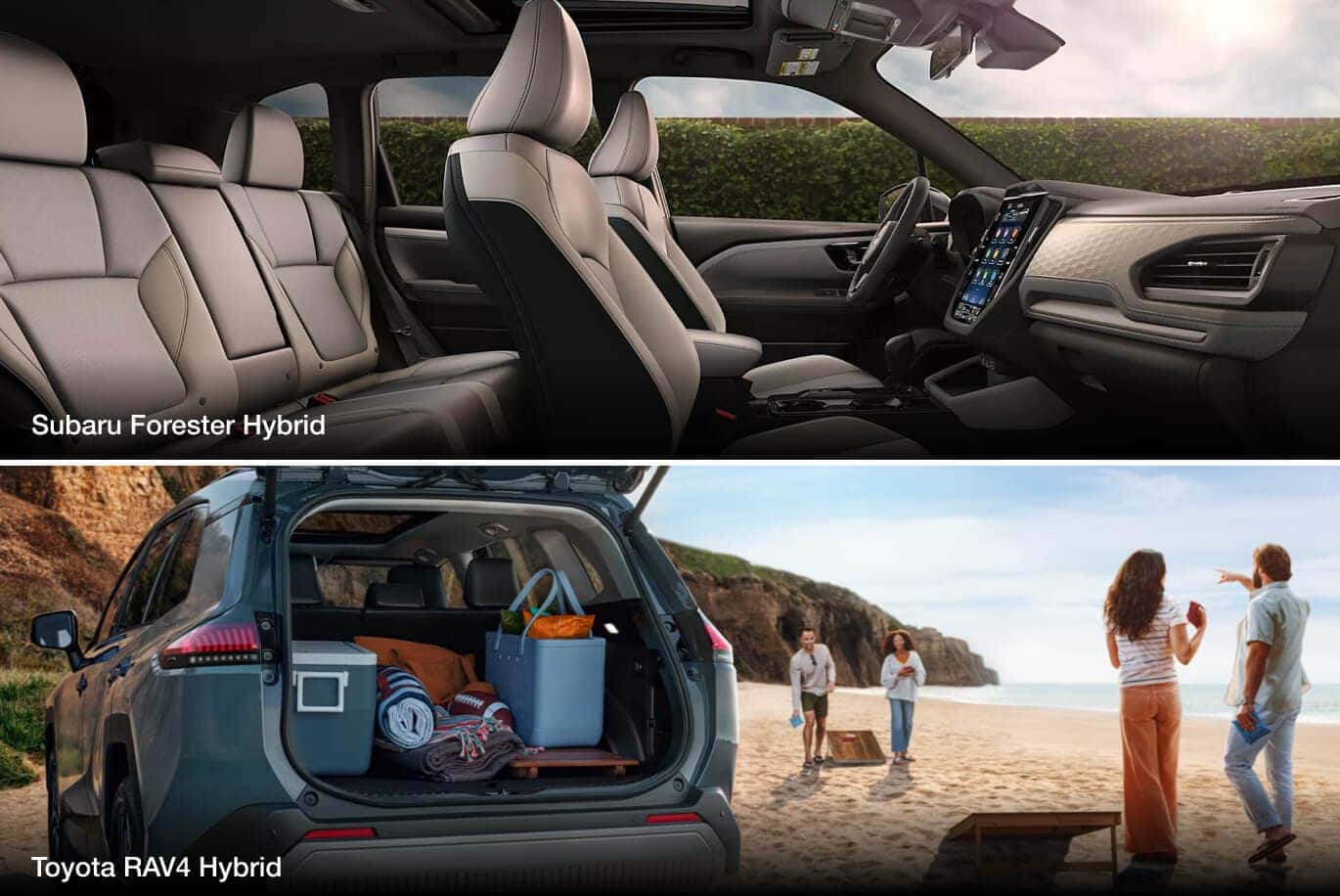
Both are five-seater SUVs, but the Forester Hybrid also gives passengers more room to spread out. It has greater front-row headroom and greater first- and second-row legroom, along with 106.6 cubic feet of passenger volume compared with 98.9 cubic feet in the RAV4.
Toyota does take a narrow win in maximum cargo space, with 70.4 cubic feet versus 69.1 cubic feet for the Forester Hybrid. That's only a 1.3-cubic-foot difference, though, hardly a victory.
| 2026 Subaru Forester Hybrid | 2026 Toyota RAV4 | |
|---|---|---|
| Trim Levels |
|
|
| Infotainment & Tech | ||
| Infotainment Display | 11.6-in Subaru Multimedia System w/ Nav | 10.5-in Toyota Audio Multimedia |
| Digital Instrument Cluster | 12.3-in | |
| Standard Sound System | 6-speaker audio system | |
| Available Sound System | 11-speaker Harman Kardon® premium audio | 9-speaker JBL® premium audio system |
| Wireless Charging | Available | Available |
| Comfort & Convenience | ||
| 10-Way Power Driver Seat | ✓ | Available 8-Way |
| Leather-Trimmed Upholstery | Available | Not Available |
| Heated Front Seats | ✓ | Available |
| Heated Steering Wheel | Available | Available |
| 2-Zone Automatic Climate Control | ✓ | ✓ |
| Panoramic Power Moonroof | ✓ | Available |
| Performance & Reliability | ||
| All-Season Tires | ✓ | Not Available |
| Trailer Stability Assist | ✓ | Trailer-Sway Control |
| Hill Descent Control | ✓ | Available |
| Paddle Shifters | ✓ | Not Available |
| J.D. Power Quality & Reliability Score | 81 / 100 (Great)3 | 71 / 100 (Average)3 |
Again, the Forester Hybrid doesn't make you climb the trim ladder for a well-equipped infotainment system, as every model comes with an 11.6-inch touchscreen and built-in navigation. The RAV4, on the other hand, starts with a smaller 10.5-inch display. Toyota does provide a larger 12.9-inch screen, but you'll need to step up to the XSE or Limited.
Audio is another area where Subaru raises the bar. An available 11-speaker Harman Kardon® premium audio system gives the Forester Hybrid an immersive soundtrack for everything from daily commutes to wilderness excursions. The RAV4 counters with an available JBL® system, but tops out at nine speakers.
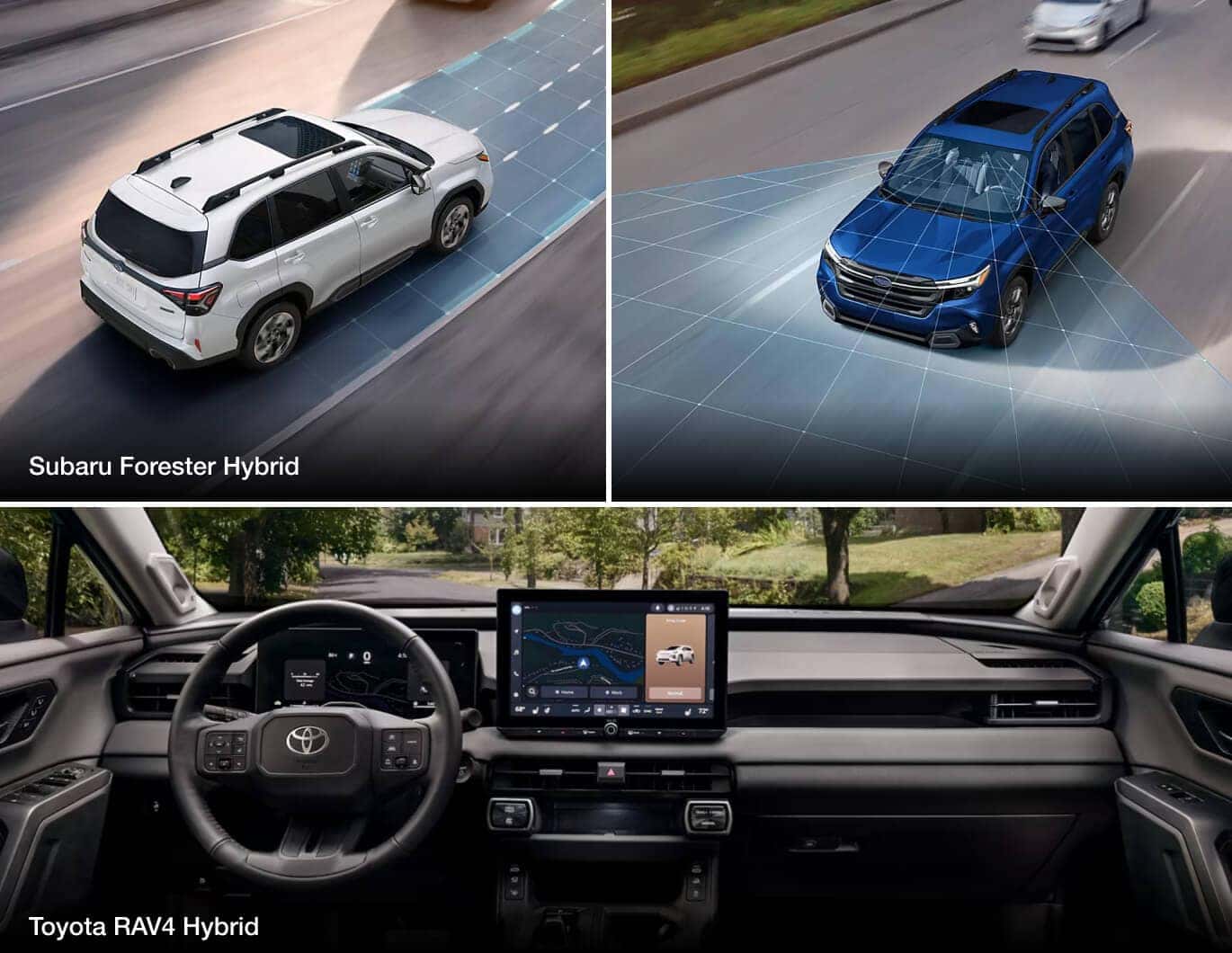
Looking at the Toyota RAV4 Hybrid vs. Subaru Forester Hybrid engine setups, the RAV4 takes the lead in max combined horsepower and fuel economy. However, the Forester Hybrid makes a stronger case for overall capability and consistency across its lineup.
Every Forester Hybrid has the same engine output, MPG figures, towing ability, and standard Symmetrical AWD. With the RAV4, those figures vary by drivetrain and trim, with FWD delivering the highest gas mileage and available AWD producing the most horsepower. Even its maximum towing capacity is limited to its two highest trims.
The Forester Hybrid further separates itself with components like standard X-MODE, which enhances traction and control in challenging conditions. Ultimately, the RAV4 may lead in combined horsepower and MPG, but the Forester Hybrid presents a consistent core performance package.
Lastly, the 2026 Forester Hybrid takes its place as the more reliable choice, earning an 81/100 "Great" Quality & Reliability score from J.D. Power.3 The 2026 RAV4 falls behind with a 77/100 score, resulting in an Average Quality & Reliability rating.3
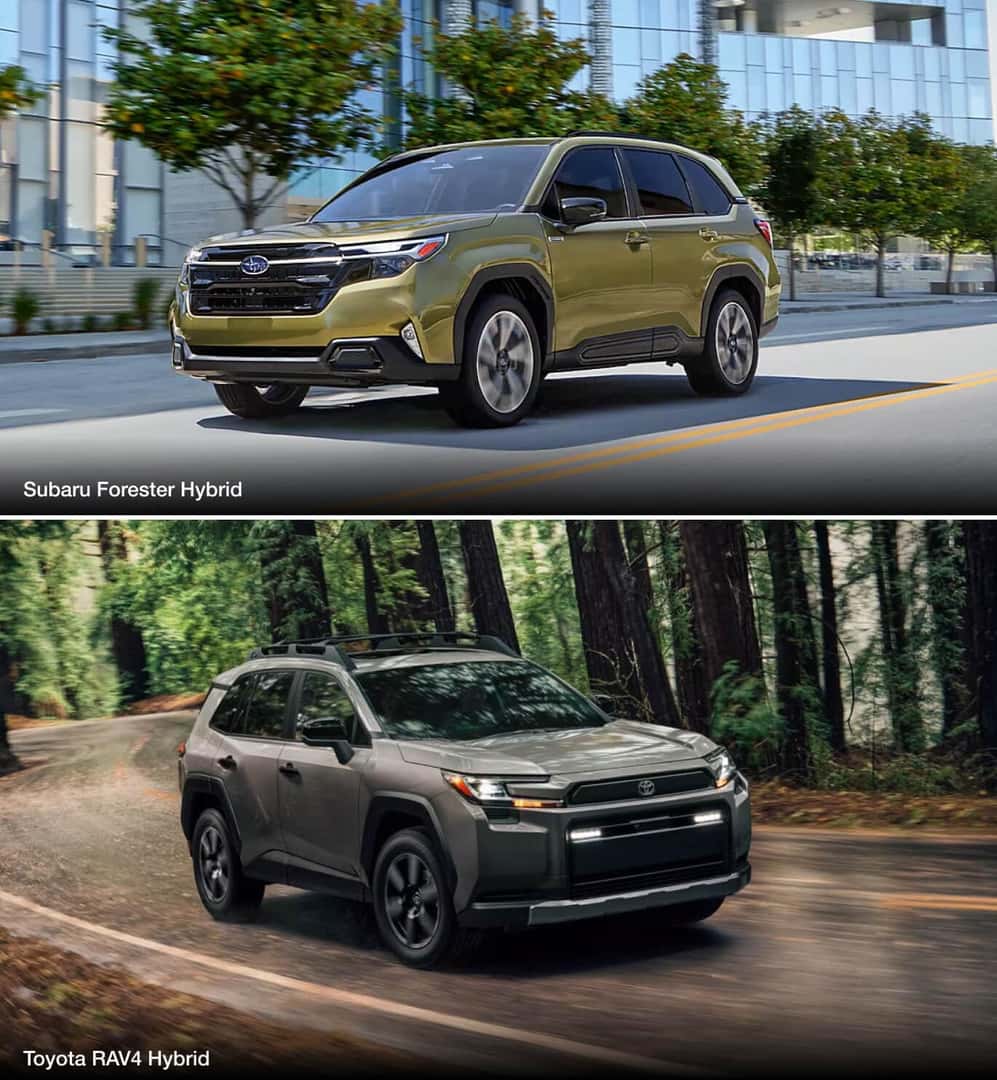
The RAV4 leads in maximum horsepower and fuel economy, but the Forester Hybrid has standard Symmetrical AWD, consistent performance across every trim, and standard X-MODE. The Forester Hybrid also earns a higher J.D. Power Quality & Reliability rating.3
With standard Symmetrical AWD, greater passenger space, generous standard technology, and higher reliability accolades, the Forester Hybrid takes the win in the areas that matter for everyday driving. Contact Capital Subaru of Greenville to compare the current lineup and discover why it stands apart from the RAV4 for yourself.
In a Subaru Forester Hybrid vs. Toyota RAV4 comparison for towing, both SUVs have capable utility. The Forester Hybrid has a 1,500-pound maximum towing capacity,4 and the RAV4 starts with a standard 1,750-pound capacity.5 The RAV4 can hit a max 3,500-pound rating,5 but it's reserved for its top two trims.
The RAV4 achieves up to an EPA-estimated 47/40/43 MPG (City/Highway/Combined),2 compared with the peak EPA-estimated 35/34/35 MPG (City/Highway/Combined)1 for the Forester Hybrid. While the RAV4 has the advantage in fuel economy, the Forester Hybrid pairs its respectable mileage with a larger fuel tank and standard AWD.
The RAV4 has a slight edge in cargo space compared to the Forester Hybrid (70.4 versus 69.1 cubic feet), but it falls short in passenger volume. The Toyota provides 98.9 cubic feet of passenger space, while the Subaru offers a more spacious 106 cubic feet.
1EPA fuel economy estimates. Actual mileage will vary with driving conditions and your vehicle's condition.
2Use for comparison purposes only. Your mileage will vary for many reasons, including your vehicle's condition and how/where you drive. See www.fueleconomy.gov.
3Reference to this third-party claim is solely for informational purposes and not to be relied upon. For details regarding this rating, visit https://www.jdpower.com/cars/
4Maximum towing capacity varies by trim level. Trailer brakes may be needed. See your retailer for details.
5Before towing, confirm your vehicle and trailer are compatible, hooked up and loaded properly and that you have any necessary additional equipment. Do not exceed any Weight Ratings and follow all instructions in your Owner's Manual. The maximum you can tow depends on base curb weight plus the total weight of any cargo, occupants, and added vehicle equipment. "Added vehicle equipment" includes additional standard/optional equipment and accessories added by the manufacturer, dealers, and/or vehicle owners. The only way to be certain of your vehicle's exact curb weight is to weigh your vehicle without passengers or cargo. (Calculated with the new SAE J2807 method.) Installation of a tow hitch receiver or other accessories located near the rear bumper or side-door kick sensors may require disabling or removing the kick sensor, and the sensor operation setting in your vehicle should be turned off. See Owner's Manual for limitations.